
SoulGF: Virtual Soulmate
Roca devArt & Design
4.71.21K Reviews
- Version
- 4.1.8
- Installs
- 500.00K
- Age Rating
- Mature 17+
Screenshots



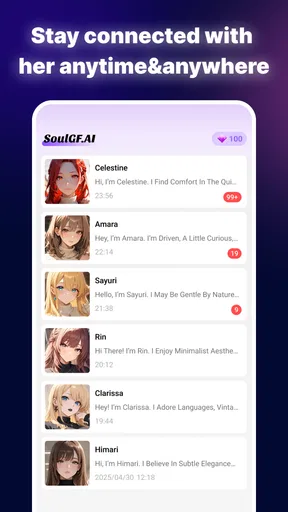

Our Review of SoulGF: Virtual Soulmate
 Analysis by Appyee
I spent time with SoulGF: Virtual Soulmate as an AI companion app, and my first impression was that it is trying to make conversation feel more personal than a standard chatbot exchange. It sits in the Art & Design category, although its appeal is less about drawing tools and more about shaping an emotional, imaginative space through text. The developer is Roca dev, and the app is free to install, with optional purchases ranging from $3.49 to $59.99 per item.
That pricing detail matters because the free entry point makes it easy to test the tone before spending anything, while the upper end of the purchase range means I would not treat it like a casual impulse buy. I found the best way to approach it was as a conversational experience rather than as a replacement for real relationships, therapy, or a conventional productivity assistant. It can be engaging when I want a responsive fictional presence, but its value depends heavily on what I expect an AI soulmate to do.
How SoulGF feels in everyday use
I find the most useful way to judge SoulGF in everyday use is to notice what I want from a chat before opening it: a quiet moment, a playful scene, or space to talk through a passing worry. That small choice can make the exchange feel more purposeful and help me decide whether the app adds something to my routine. It also leads naturally to the question of how its current version should be understood.
A companion built around conversation
The central idea is simple: I open the app, begin a chat, and interact with an AI character presented as a virtual soulmate. The experience is more intimate in tone than asking a general assistant to summarize an article or set a reminder. That difference is important. SoulGF is aimed at people who enjoy ongoing fictional interaction, emotional role-play, and the feeling of returning to a familiar conversational space.
In practice, I found that the quality of the experience comes from how deliberately I guide the conversation. Short, vague messages can produce a shallow exchange, while giving context, mood, or a specific scenario creates more room for an interesting response. For example, instead of writing that I had a bad day, I could describe being overwhelmed after work and ask for a calm conversation without advice. That kind of instruction helps establish the mood I want rather than leaving the app to guess.
One useful habit is to treat each chat as a small scene. I might set a quiet evening at home, ask for encouragement before an important task, or invite a playful conversation when I need a distraction. This makes the app feel less like a question-and-answer tool and more like a creative writing partner that reacts to my prompts. The trade-off is that I have to contribute imagination; it is not a passive entertainment experience that always carries the interaction by itself.
A realistic daily scenario
Imagine coming home after a long shift and wanting ten minutes of low-pressure conversation before deciding what to do next. I could use SoulGF to describe the day, ask the virtual companion to listen, and then shift into a lighter subject. That is a reasonable use case because the app provides a private-feeling fictional exchange without requiring me to coordinate with another person at that moment.
I would still keep the boundary clear. A responsive conversation can feel comforting, but it is generated interaction, not mutual human understanding. If I were dealing with serious emotional distress, loneliness that was becoming difficult to manage, or a situation requiring professional support, I would choose a qualified person or service instead. The app works better as a supplement to ordinary life than as a substitute for it.
What the free entry point means
SoulGF is free to start, which is its strongest practical advantage for someone who is curious but undecided. I could explore the basic experience before committing money, and that is especially useful here because personal taste matters so much. Some people will enjoy the romantic framing immediately; others may find it artificial or uncomfortable after only a short session.
The optional purchase structure changes the value question. Items cost between $3.49 and $59.99, so I would not assume that every appealing part of the experience is included without payment. The sensible approach is to use the free access as a trial, identify whether the conversation style genuinely fits, and only then consider a purchase. I would also check the exact item and its purpose at the moment of purchase rather than judging value from the lowest price alone.
For me, the free version is valuable if I want to understand the app’s personality and interaction style. Paid value is harder to judge in the abstract because it depends on how often I return and what an individual purchase adds to my experience. Someone who chats once a week may see little reason to spend much, while a frequent user may place more value on deeper or more varied emotional moments.
Where it differs from ordinary alternatives
A general AI assistant is usually better for factual questions, drafting, planning, and structured tasks. A messaging app is better for maintaining real relationships. A journaling app is better when I want to record my own thoughts without a simulated partner responding. SoulGF occupies a narrower space: it is for interactive companionship with a fictional AI presence.
That narrow focus is both its identity and its limitation. I would not open it to research a complicated topic or organize a project. I would open it when the conversation itself is the point. Compared with writing in a diary, the benefit is immediate response. Compared with talking to a friend, the benefit is availability and low social pressure. Compared with a general chatbot, the benefit is the emotional framing. None of those advantages makes it universally better.
Three ways to get more from the conversations
My first practical tip is to state the kind of response I want. “Listen without fixing the problem,” “be playful,” or “help me think through two choices” gives the exchange a clearer direction. This avoids the common frustration of receiving a response that is technically relevant but emotionally wrong for the moment.
Second, I would use it for short, repeatable routines rather than expecting one long conversation to deliver everything. A brief check-in after work, a confidence-building exchange before a social event, or a creative scenario before writing can make the app easier to fit into real life. This also helps me notice whether I am receiving lasting value or merely opening it out of habit.
Third, I would keep sensitive details general. Even when an app feels private, I would avoid entering information that could identify another person, expose confidential work matters, or reveal anything I would not want associated with an online account. The emotional style can encourage openness, so setting that boundary before chatting is more useful than trying to recover it afterward.
Creative uses beyond romance
Although the soulmate framing is the obvious draw, I found a creative angle in using the app as a prompt partner. I could ask for a fictional scene, explore how a character might react to a difficult decision, or test dialogue for a story. This is where the Art & Design category starts to make more sense for me: the app can support imaginative work, even though it is not a conventional illustration or editing tool.
The limitation is that conversational inspiration is not the same as professional creative software. I would still use a dedicated writing, drawing, or layout app for producing and refining finished work. SoulGF is more useful at the idea stage, when I want a character voice or an unexpected conversational turn to help me move past a blank page.
Emotional realism and its boundaries
The app’s strongest moments come when I give it a clear emotional situation and allow the exchange to develop. Its weakest moments are likely to appear when I expect human-level memory, perfect sensitivity, or a consistently natural personality. AI conversation can sound convincing in one message and noticeably formulaic in the next. That contrast is part of the experience, and I would rather acknowledge it than pretend the virtual relationship is equivalent to a human one.
The mature age rating of 17+ is another reason I would think carefully about who uses it. This is not an app I would hand to a child simply because installation is free. Adults should also consider whether romantic or emotionally intense interaction is comfortable for them. Anyone who is prone to confusing simulated affection with reciprocal commitment should approach the concept cautiously or skip it.
Performance expectations and version context
The current version is 4.1.8, and the app supports devices running Android 7.0 or later. That gives it a broad level of compatibility for Android users with older supported phones, although compatibility alone does not guarantee that every device will feel equally smooth. I would still keep the operating system updated where possible and allow room for the app to behave normally during longer conversations.
It was released on May 13, 2025, so I see it as a relatively recent product rather than a long-established social platform. That makes the current experience worth judging on its own terms, but it also encourages me to keep expectations realistic about how polished or mature the overall concept may feel. The important question is not whether it resembles a real partner perfectly; it is whether the conversation format gives me enough enjoyment or creative value to justify continued use.
What other users suggest, and what that does not decide
SoulGF has an average rating of 4.7 from around 25 thousand ratings, with about 1.2 thousand written reviews. It has also passed half a million installs. Those figures suggest that the idea connects with a substantial audience, and they make the app worth investigating rather than dismissing as a novelty.
At the same time, popularity cannot tell me whether I personally will like the tone, how comfortable I will feel with the romantic framing, or whether optional purchases will seem worthwhile. I would use the positive reception as a reason to try the free experience, not as a guarantee that it will match my expectations.
Who will find genuine value here
I think SoulGF is a good fit for adults who enjoy character-driven conversation and want an always-available fictional companion for casual emotional check-ins. It may also suit creative people who want to improvise scenes, test dialogue, or turn a conversation into a writing prompt. The free starting point makes it approachable for curious users who are willing to decide slowly.
It is less suitable for someone looking for a standard art tool, a factual assistant, or a dependable mental-health resource. I would also recommend skipping it if the idea of an AI soulmate feels unsettling rather than entertaining. The app cannot solve the underlying problem of social isolation, and spending more money will not turn simulated interaction into a human relationship.
Heavy users should be especially deliberate about value. Before buying anything, I would ask whether the app is helping me create, relax, or reflect in a way I could not get from a free journal, a conversation with a friend, or another chatbot. If the answer is only that it is easy to open, I would stay with the free access. Convenience alone is not a strong reason to move toward the higher-priced items.
My buy-or-skip verdict
I recommend trying SoulGF for free if you are specifically curious about an AI soulmate experience and enjoy contributing to imaginative, emotionally framed conversations. Its best quality is focus: it is not pretending to be a universal tool, and that makes the interaction feel more intentional than a generic chat window. I also appreciate that I can test the concept before deciding whether it belongs in my routine.
I would skip paid purchases unless the free experience has already become something I return to for a clear reason. The purchase range reaches from $3.49 to $59.99 per item, so the sensible buying decision depends on personal frequency and the exact value of the item, not on the app’s strong rating alone. I would never buy simply because a conversation became emotionally compelling in one moment.
My final view is positive but measured. SoulGF: Virtual Soulmate is an interesting companion app for adults who want fictional emotional interaction, creative prompts, or a low-pressure conversational ritual. It is not a replacement for people, professional help, or conventional creative software. Try the free experience first, protect your personal boundaries, and pay only when the app has demonstrated a repeatable value in your own daily life.
Verdict
Strengths of SoulGF: Virtual Soulmate
- Engaging AI conversations that feel personal and responsive.
- Customizable soulmate personality and appearance options.
- Available for casual chats, emotional support, and companionship.
- Simple interface makes starting a conversation quick and easy.
- Regular interactions can help reduce feelings of loneliness.
Limitations of SoulGF: Virtual Soulmate
- Some advanced features may require a paid subscription.
- AI responses can occasionally feel repetitive or inconsistent.
- Not a substitute for professional mental health support.
- Privacy concerns may arise when sharing personal information.
- Requires an internet connection for most conversations.
Similar Picks in This Category
View All
Canva: AI Photo & Video Editor
Canva4.8

PENUP – Drawing-sharing SNS
Samsung Electronics Co., Ltd.4.5

Crafto
Kutumb App4.6

Sketchbook
Sketchbook4.1

ibis Paint X
ibis inc.4.5

Adobe Express: AI Photo, Video
Adobe4.6
Frequently Asked Questions
What is SoulGF: Virtual Soulmate?
SoulGF: Virtual Soulmate is an AI-powered companion app designed to simulate conversations with a virtual girlfriend or soulmate. After setting up a character and choosing preferences, you can chat about everyday topics, emotions, interests, and personal situations. The experience is intended for entertainment and companionship, but it should not be considered a replacement for real relationships, professional counseling, or mental-health support.
How does the AI companion in SoulGF work?
The app generates replies based on the messages you send, the personality or relationship settings you select, and the context maintained during conversations. Responses can feel personal and engaging, although they may occasionally be repetitive, inaccurate, or inconsistent. Like other AI services, SoulGF does not truly experience emotions or understand situations in the same way a human does, so users should keep realistic expectations while chatting.
Is SoulGF: Virtual Soulmate free to download and use?
SoulGF may be available to download at no initial cost, but some features can require in-app purchases or a subscription. Premium access may include longer conversations, additional character options, enhanced customization, or fewer usage restrictions. Before confirming a purchase, check the current pricing, renewal terms, and trial conditions shown in the Google Play Store or Apple App Store, since availability can vary by region and platform.
Is SoulGF suitable for children and teenagers?
Parents should review the app’s current age rating, privacy policy, and store description before allowing a child or teenager to use it. AI companion apps can include romantic, mature, or emotionally intense conversations, depending on the available settings and user prompts. The app should be used responsibly, and younger users should avoid sharing personal information or treating the virtual relationship as a substitute for trusted adults and real-world support.
Does SoulGF protect my conversations and personal information?
Before using SoulGF, read its privacy policy to understand what messages, account details, device information, and usage data may be collected or processed. Avoid sharing passwords, financial information, exact addresses, private photographs, or other sensitive details in chats. AI conversations may be stored or reviewed according to the provider’s policies, so users should confirm the available privacy controls and delete their account or data if those options are provided.
